
Reading Time: 10.8 mins
September 9, 2026
This article aims to help you and your family apply healthy habits in your home to enjoy screen time in moderation, so devices don’t have to seem so devious.
If you’ve seen Toy Story 5, you may remember the scenes of houses radiating blue from every window, with children glued to glowing screens. Outside, the forgotten toys in the yard mourned that the days of imagination and play were over ever since tech had invaded homes and absorbed children’s attention.
Thankfully, the devices in our homes are not like ‘Lilypad’, the menacing tablet in Toy Story 5. They are not conscious beings, readily fighting off other forms of fun and creativity. Instead (much like the toys realised by the end of the movie) it’s possible to take control of screen time and put tech in its place so that the online and gaming worlds can be empowering spaces for young people and enjoyed alongside other fun. From toddlers to teens, this article provides you with healthy habits you can implement in your family so screens can be a productive use of time, without taking up all of their time.

How Much Is Too Much?
When it comes to screen time, there isn’t a single ‘right’ number for every child. What’s important to note is not only how much screen time, but what children are consuming and how. Focusing on the number of minutes or hours might not be the best measure of a healthy screen time use. A video call with a long-distance family member or friend or an evening set aside to learn a new skill from YouTube is not the same as a two-hour bedroom “doomscroll”.
In March 2026, Ofcom revealed that for 8–14-year-olds, the daily average time spent online across smartphones, tablets and computers was 3 hours and 36 minutes. Average time online increased with age with 15–17-year-olds spending on average 6 hours and 20 minutes daily. Almost four in ten of 8-17-year-olds say they think they spend too much time on screens.
Why Do Children and Young People Spend So Long on Screens?
Have you ever asked the question:
“What’s so interesting on that phone anyway?” or “Haven’t you spent enough time on that game today?”
Understanding the appeal can make it easier to move forward with a healthy and empathetic action plan for your family (and hopefully avoid some of the meltdowns and repeated arguments).

So, what’s the problem?
If children and young people enjoy spending time online, and it’s what everyone else is doing, are there any real dangers? It’s important to be aware of both the online and offline risks which are associated with excessive screen-use as well as what is replaces:
Start with a conversation
Giving your children a say in your family’s screen time boundaries makes them a fair, inclusive agreement rather than a punishment. Rather than trying to set rules during a late-night protest, pick a calm moment such as around the dinner table, or at the weekend.
Explain that you’re not being ‘overprotective’ but rather you’re protecting them and your relationship with them. Be honest that you struggle with it too, so it’s a plan for the whole family. Listen actively to find out what matters to them on screens and why, while making clear that you know what harms are out there. That may mean a difficult but necessary conversation about online dangers (such as grooming, pornography and harmful content and cyberbullying). Handled in an age-appropriate way, it makes you their teacher, rather than leaving the online world to be their classroom.

Healthy Habits and Tips for your Home
Small, consistent habits make a big difference. By implementing some of the following healthy routines and boundaries, you can set your family up to win.
Build in regular breaks
Encourage your child to step away from the screen regularly to stretch, move around, rest their eyes and enjoy other pastimes. Getting into the habit of doing these at natural pause points, such as at the end of an episode or after a level (may make your family look crazy but…) can be an effective way to take breaks.
Include more productive screen time
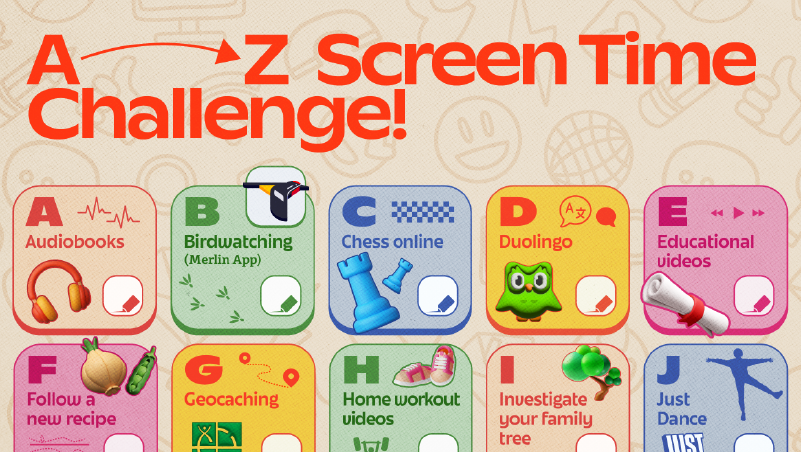
Find ways that screens can be enjoyed together or ways to avoid the endless doomscroll. We’ve compiled an A-Z checklist of potential ideas below!
Fill the time with offline activities
Replacing screen time with the offer of something more exciting can help fill the time with other activities. See our ideas below for younger and older children.
Keep screens in the open
Co-view or supervise screen time, especially for young children. For older children, encourage talking openly about what they’re watching, asking questions, and connecting it to real life. Not only does this bring a point of connection, it helps young people to know that they can come to you if they see something worrying online.
Create screen-free zones and times
Simple, consistent boundaries work best e.g. – no screens in bedrooms, in the hour before bed, or at the table and phones charge overnight in the living room (you may need to invest in more bedtime stories and alarm clocks!).
Be fair with countdowns
If you said 15 more minutes, stick to it. It might help to have a visual timer to show that you’re not cheating them out of precious seconds. Alternatively, recognise that sometimes, an agreement to “one more episode” or “until I finish this level” might be a kinder and fairer boundary than a timer.
Mind the content, not just the clock
Choose quality, age-appropriate content over fast, chaotic “brain rot” – steering clear of frantic, attention-grabbing videos. Check out our Safety Centre for guidance on parental controls, content filters and account set-ups to minimise the risk of young people stumbling across or seeking out harmful content.
Set device-level limits together
Apple Screen Time and Google Family Link let you cap daily use per app, schedule downtime and approve new downloads. Set them up with your child rather than behind their back; they’re more likely to stick to limits they helped choose.
Make screens less stimulating
Encourage switching to greyscale (which turns your device to black and white), minimising notifications, auditing followers, using Do Not Disturb or Focus mode, deleting unused apps and hiding the tempting ones off the home screen. Small changes can make a device easier to put down.
Set the example
Often, if adults are glued to their phones or spending hours on a game every evening, that’s the norm young people will copy. Being a good role model and following your house rules too sets a powerful example.
Consider Christmas and holidays
For gifts, think of non-screen activities you could encourage so they’re not always getting the latest game. Consider other hobbies they may enjoy like sports equipment, board games, books, toys, roller skates, a bike or art supplies.
Be the chauffeur or host
Sometimes, children and young people may want to see their friends rather than sit at home on their device, but practicalities get in the way. It may be helpful to facilitate the plans they want to make with their friends by offering to drive or host.
Beat the Scroll
Screen-Free Ideas
It can be easier to hand a child a tablet for a while, or to let a young person spend an afternoon scrolling (especially if it’s what they want to do). But, with a bit of planning, everyone can enjoy the benefits and the boundaries of a more balanced approach to screen time.
Younger children
A “boredom jar” of craft projects, baking, den-building, scavenger hunts, parks, cycling, library trips, nature walks with a checklist, board games, jigsaws, helping with cooking, gardening or the shopping, outdoor messy play, Playdoh, chalk drawings, dress-up box, swimming, den-building, junk art, kite flying, water fights, a DIY gallery or fashion show or create a bug hotel.
Older children
A bucket list to tick off together, a reading challenge, a recipe to master, a place to visit, a skill to learn; beach or hiking days, Couch to 5K, five-a-side, sea swimming, dog walking, bigger jobs at home like cooking for the family or a gardening project, quizzes and teamwork games with friends, handmade projects such as friendship bracelets, crochet, origami or woodwork, a first part-time job, journalling, thrifting, watercolours, Lego or the gym for 16 and over.
Screen-Smart Ideas
Take advantage of the countless positive uses of screens that exist in the world today. These encourage quality time spent together and combat the mindless solo scroll.
Ideas include reading eBooks on the Libby app, New York Times games, following a YouTube tutorial for a new skill or instrument, a family movie night, multiplayer video games, party games on apps, recording a fun video/vlog together, challenges like GeoGuessr or online quizzes, documentaries or educational videos, language learning, writing, creating or digital drawing.
You’ve Got This
By the end of Toy Story 5, the answer wasn’t to throw every device out of the window, it was to take charge and make room for play, imagination and connection alongside screens. For your family, that routine is achievable. Focus on quality over quantity, protect sleep and family time, watch together where you can, and remember the value of offline fun too.

© 2026 Disney/Pixar. All Rights Reserved.
Ineqe Safeguarding Group | ineqe.com | Safer Schools | saferschoolsni.co.uk and oursaferschools.co.uk
Join our Online Safeguarding Hub Newsletter Network
Members of our network receive weekly updates on the trends, risks and threats to children and young people online.